
On Being in Pain
And rejecting false hope

Click this button to anonymously submit a question for Ask a Therapist:
My mother-in-law was visiting this week. She lives out of state, so we only see her a few times a year. Every time I see her, she asks me some variation of this question: “How is your ankle? Is it better yet?”
I wrote last July about my hidden disabilities, including the ankle injury that resulted in two surgeries that left me with a ten-inch scar stretching along the side of my right foot and up to the middle of my calf. While some might perceive my mother-in-law’s inquiry as a show of caring and concern, it bothers me because it’s a leading question. I know the answer she is looking for. She wants me to say, “It’s great, all better, good as new!” My ankle is not better. It causes me pain every day. Four years after the initial injury, and nearly three years after my second surgery, my ankle is still swollen most of the time, and I limp after long days on my feet. I still have to wear expensive orthotic insoles for support and will never be able to properly point my right toes again. I have given up dancing, a lifelong passion.
My mother-in-law doesn’t want to hear that. Roughly once a quarter, she asks me this question, and once a quarter, I give her some variation on this answer: “It’s not better.”
“Well, maybe it will get better,” she replies. “Healing takes time.”
“It’s not getting better. This is as good as it’s going to get,” I insist.
She follows up with: “How’s your finger?”
I also wrote about the role my in-laws played leading up to a family hike where I fell and dislocated my pinky.
I hold up my hand to show her my bent digit. “It’s permanently disfigured.”
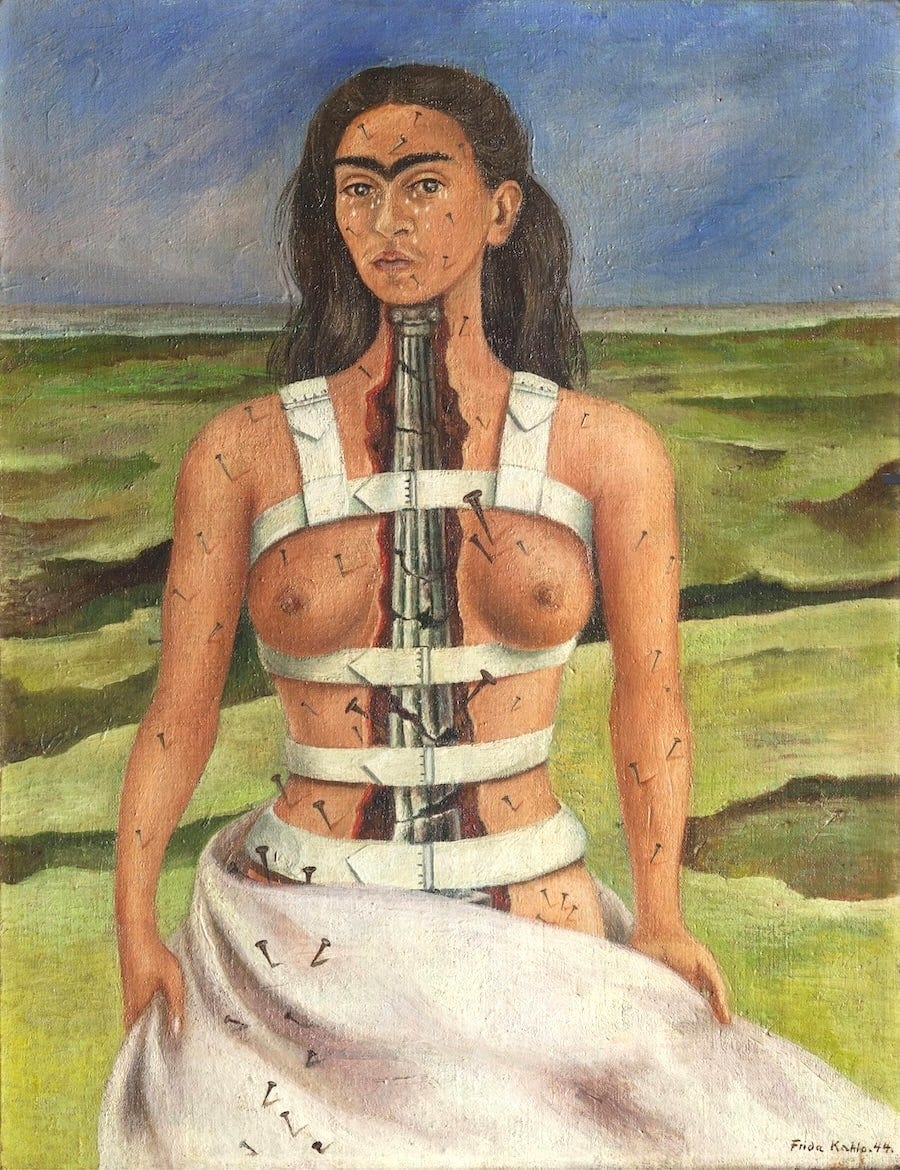
Someone who is nicer than I am might give my mother-in-law the answer she is looking for, the reassurance that everything gets better if you just give it enough time and try hard enough to fix it. This dynamic will be familiar to anyone who has chronic illness or disabilities. The able-bodied among us want reassurance that something catastrophic won’t happen to them, or that if it does, they will persevere and be rewarded with full bodily restoration. When you refuse to stick to the script, refuse to be someone’s inspiration porn, people sometimes turn on you and blame you for your misfortune, muttering about how a positive attitude can go a long way toward making you better. Other times, they withdraw because they prefer not to be confronted with the reality that sometimes shitty things happen for no good reason and you never fully recover. My mother-in-law keeps asking the same question hoping to get a different answer, and I keep disappointing her.1
Pain has been my near-constant companion this past year. My injury left me with nerve damage that made the outer edge of my foot and my two smallest toes mostly numb. This caused problems for my balance, but having a part of my body that couldn’t feel anything wasn’t the worst, honestly. The surgeon told me that the nerves would repair themselves slowly, growing at the rate of a millimeter per day. I can tell that the nerves are growing back because I have regained some sensation: a tingling feeling of being pricked with a thousand tiny pins, punctuated occasionally by a jolt that shoots through my foot.
My autoimmune illnesses have also been acting up this year. I caught a cold at a Memorial Day barbecue last year that caused my psoriatic arthritis to flare. The flare stretched all the way through January, leaving me fatigued and dejected, wondering if this was my new baseline. My body felt like a bag of wet sand I was dragging around, or, as Lena Dunham memorably described it in Famesick, “like towing a wrecked car across town at midnight.”
The flare finally ebbed, but the reprieve was short-lived. I began experiencing debilitating back and hip pain from ankylosing spondylitis (AS) in the spring. Sitting for three back-to-back therapy sessions became challenging, and I know my clients noticed me visibly squirming and shifting in my seat. I sometimes involuntarily yelped in pain when I went from sitting to standing, or standing to sitting. My rheumatologist changed my medication, but I am still waiting for insurance to authorize it. Thankfully the AS flare has subsided, ending as inexplicably as it began.
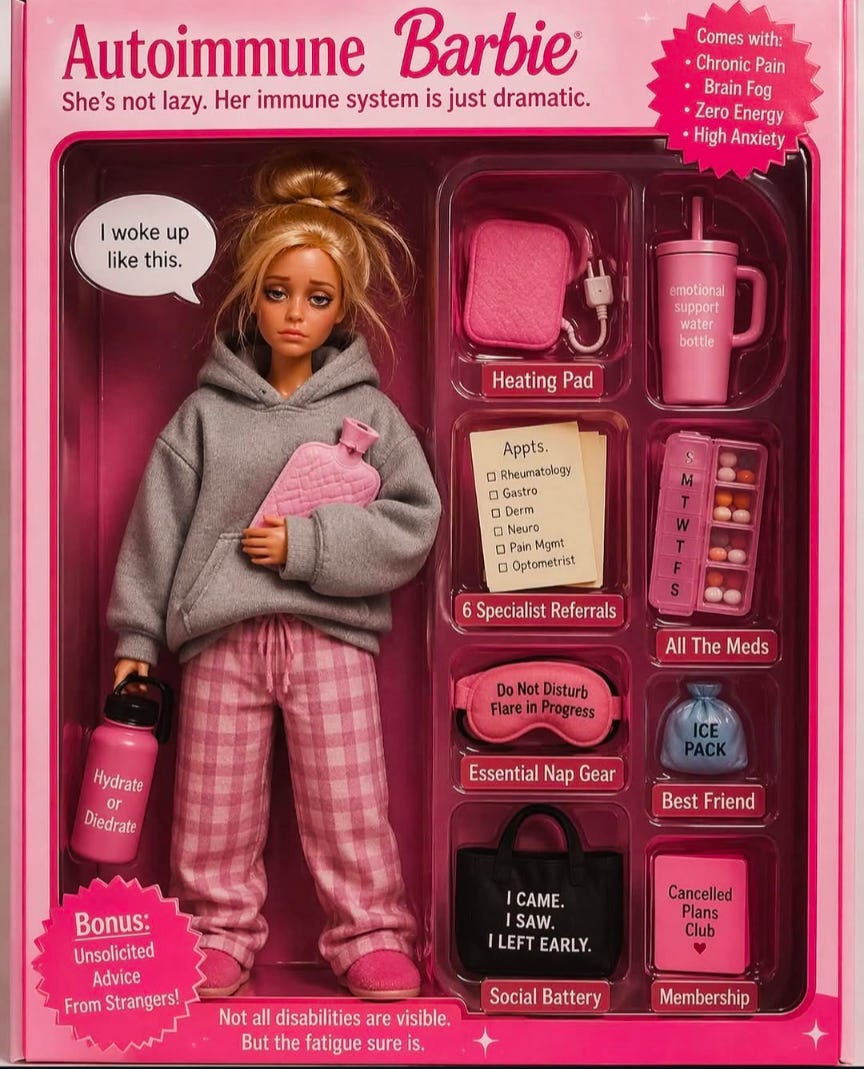
Whenever I write about my health, I worry that no one wants to read about someone else’s ailments, but when I recently read Meghan O'Rourke’s memoir, The Invisible Kingdom: Reimagining Chronic Illness, I was spellbound by the play-by-play of her long road to diagnosis and treatment after she became mysteriously ill. O’Rourke fell down every wellness rabbit hole along the way, from doubling down on an anti-inflammatory diet, to questioning whether her symptoms were a somatic response to her mother’s death. It was validating that even someone as brilliant and accomplished as O’Rourke was vulnerable to exploitation by the quacks and grifters of alternative medicine in her desperation to find relief from her symptoms.
One of the things I appreciated most about O’Rourke’s story is that she refused to tie it up at the end with a pretty bow, instead leaving the messy raw ends exposed. While she did get some diagnostic clarity and symptom relief, O’Rourke was left with questions and the lingering fear that her symptoms might return. This reflects the lived reality for almost all of us who have chronic conditions. While our culture favors the triumphant narrative of the sick person who finds a cure and is restored to good health, very few of us are fortunate enough to experience that tidy trajectory.
While I was experiencing the worst of my AS flare this spring, my aging greyhound was having a parallel experience. Luna has been a quietly majestic presence in our household since we adopted her in 2020. She glides silently from room to room, materializing by my side to tuck her head unassumingly under my hand. She is so quiet that my brother likes to joke that she’s not a dog, she’s a cat on stilts. Up until recently, she was still doing 45 mph sprints in the backyard just for the fun of it.
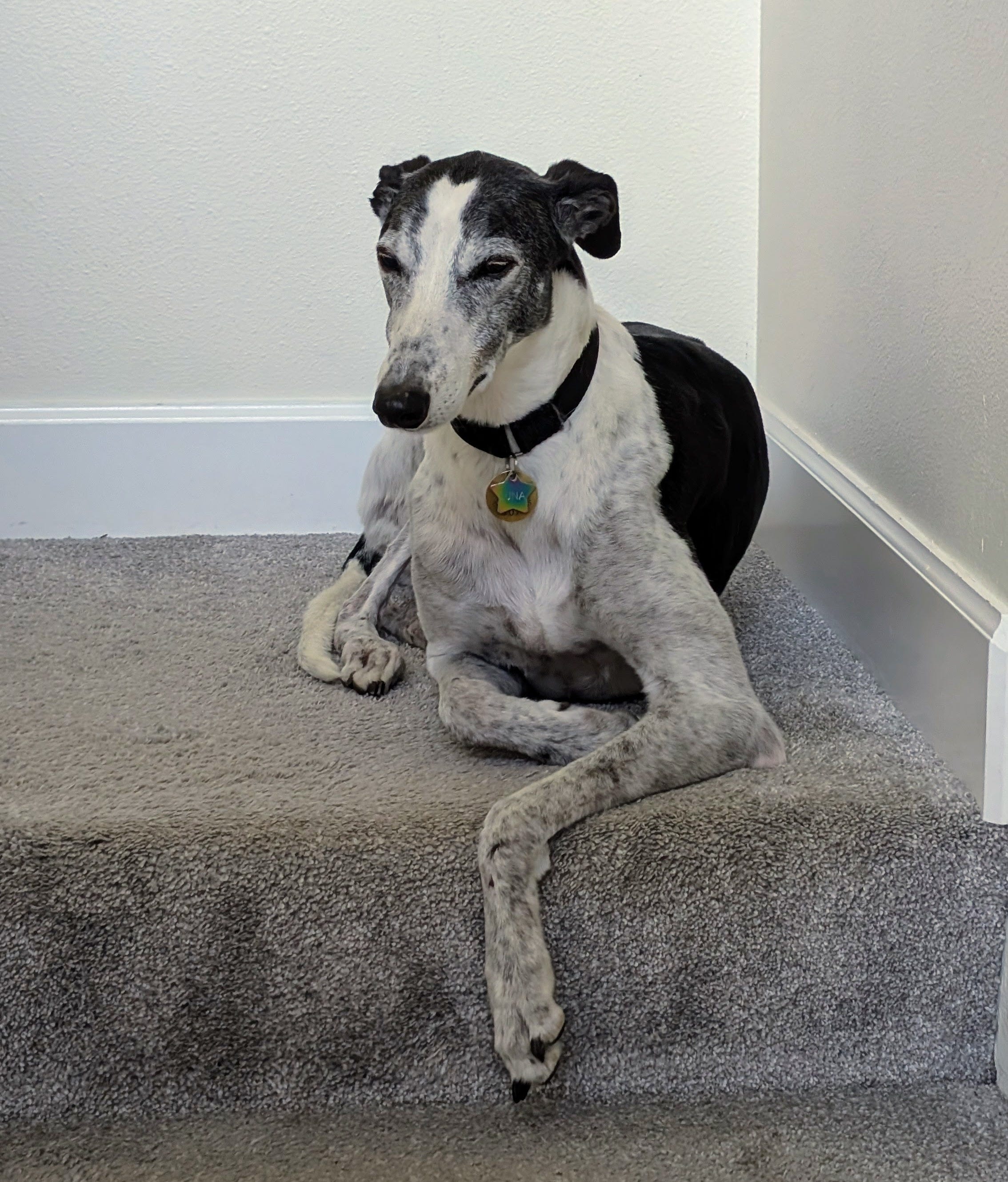
That changed suddenly this spring. My husband and I were winding down for the night when we heard an unearthly keening from downstairs. We rushed down to find Luna stuck in the horizontal splits, unable to stand up. In one night, our powerful dog went from running laps and taking long walks, to struggling to keep her feet underneath her. As her condition worsened, our formerly stoic dog started pitifully whining throughout the night in pain.
It struck me that Luna’s pain seemed more objectively real than my own. One day she was not in pain, and the next day she was, and there could be no doubt about it. She wasn’t imagining it. She wasn’t overreacting. It wasn’t all in her head, and it certainly wasn’t her fault. Pain was now a fact of her existence.
Witnessing Luna’s pain was the inverse of Elaine Scarry’s famous quote from The Body in Pain: The Making and Unmaking of the World: “To have pain is to have certainty; to hear about pain is to have doubt.” I had no doubt that Luna was in pain, but I often distrust my own pain. I second-guess myself and wonder whether I just need to stretch, or force myself to take a walk, or get a better night’s sleep. I wonder if it’s a symptom of stress, or whether fixating on my pain is making it worse. I am mostly able to resist succumbing to diet culture now, but I used to wonder if inflammatory food was to blame, thinking my pain might recede if I never ate another cookie or french fry.
When my dog was in pain, she didn’t gaslight herself, blame herself, or try to bargain or manifest or otherwise think her way out of it. She didn’t shame herself for not having a positive mindset. She communicated her suffering with a low, continuous whine that expressed that something was seriously wrong. I didn’t envy her suffering, but I envied her clarity about it.
After trying several interventions that didn’t work, the vet put Luna on steroids, which thankfully eased her pain and improved her mobility. When we tried to wean her off the steroids, her symptoms quickly returned, so the vet concluded that our best option is to keep her on steroids for the rest of her life.
I will also be on some combination of meds for the rest of my life. I’m hoping the new medicine from my rheumatologist will help control my symptoms, but I also accepted long ago that chronic pain is a fact of my life. Jessica Slice made a similar observation here, and was chastised for it by her physical therapist:
“Nearly a decade ago, I was seeing a physical therapist who specialized in EDS. I really liked him. I still do his exercises. One day, as we were fine-tuning my approach to the nerve pain in my arm, I made a throwaway comment about the fact that I will always be in pain. I said this because my body has hurt every moment of my life, and there is no reason to think it will stop. It is the nature of my collagen. I do my very best to take care of my joints and muscles and to ease my own suffering but pain has been, and will be, there.
My PT was so mad. He said that with a mindset like that, I was ensuring that my pain wouldn’t improve. That I had to believe I could fully recover, so that I would. I found his response so jarring. Why would I believe that? There is absolutely no evidence that even the most diligent approach to PT will fix the structural integrity of my connective tissue.
If determination and relentlessness could solve my problems, I would live in a state of bliss. But that’s not how this life works.”
Well-meaning friends, family, and medical providers want us to hold onto the idea that we will get better one day, not understanding that holding onto an unrealistic hope like that is more damaging than productive. I always come back to the Buddhist tenet that pain is inevitable, but suffering is optional. Experiencing pain is an unavoidable fact of being alive. When we react to that pain by grasping for unattainable outcomes, blaming ourselves, or lamenting our fate, it does nothing to change the fact of our pain, but significantly increases our suffering. Accepting that we will be in pain is to embrace reality instead of struggling against it.
My mother-in-law will keep asking her quarterly question, and I will keep declining to give her the answer she is looking for. I am not getting better. That’s okay. Truly. Sometimes I still grieve the loss of my body as it was, but most of the time now I accept that it is what it is, and there is peace in that.
What is your relationship with pain like these days?
Find every book I have ever recommended at the Other Interests Bookshop!
Thanks for reading Other Interests. If this post resonated for you, please tap the heart icon to let me know. If you’re thinking about leaving a comment, don’t be shy, just do it! The best discussions happen in the comments.
If you value the work that goes into writing Other Interests, please consider becoming a paid subscriber. If would like to leave a tip without committing to a paid subscription, you can do that here:
My in-laws don’t read my Substack, in case you were wondering.
I haven't read The Lady's Handbook! I will check it out!
I went down the anti-inflammatory diet rabbit hole when I was first diagnosed with arthritis thinking maybe I could avoid the biologic drugs that are the first line of treatment. It made absolutely no measurable difference for my symptoms. As my doctor later said to me, once inflammation reaches the stage of causing chronic illness and joint damage, an anti-inflammatory diet is not going to move the needle. The bulk of my diet is still low-inflammatory food because, you know, why not, but I no longer think that I might cure myself by strictly abstaining from fried or processed foods or eating only organic produce.
I have the same issue with parents. They seem to believe that I'm just one more supplement or treatment from being well. Though when I decided to take time away from to work on my mental health is was all "what is that going to do?" I stopped looking for their approval long ago but it is still frustrating in a world where more support is what would actually help.